
In today’s fast-moving digital landscape, speed is a competitive advantage—but only when it does not compromise stability. Many organizations adopt DevOps with the promise of faster releases, yet struggle with outages, security issues, or declining system reliability. In 2026, DevOps is no longer about moving fast at all costs. It is about improving delivery speed without breaking systems.
This article explores how DevOps works in practice, what successful teams do differently, and how organizations balance velocity with resilience. Fast Tract IT Services – FZCO helps businesses implement modern DevOps practices that accelerate innovation while maintaining system stability, security, and long-term operational reliability.
Why Speed and Stability Often Conflict
The Pressure to Release Faster
Business demands for rapid innovation push engineering teams to release more frequently. However, without the right DevOps practices, increased release speed can introduce:
- Unstable deployments
- Configuration errors
- Higher incident rates
DevOps exists to resolve this tension—but only when implemented as a system-wide approach rather than a set of tools, avoiding common cloud architecture mistakes that undermine stability.
DevOps Is More Than CI/CD Pipelines
A common misconception is that DevOps equals automation pipelines. While CI/CD is essential, DevOps also involves culture, process, and accountability. Teams that focus only on tooling often miss the practices that actually protect system stability.

Core DevOps Practices That Improve Speed Safely
Small, Frequent Changes
High-performing DevOps teams deploy smaller changes more frequently. Smaller releases reduce risk by:
- Making issues easier to detect
- Simplifying rollbacks
- Limiting the blast radius of failures
This approach allows teams to move faster overall while maintaining system reliability.
Automation Everywhere It Matters
Automation is central to DevOps success. In practice, this includes:
- Automated testing at multiple stages
- Infrastructure as Code (IaC)
- Automated deployments and rollbacks
By removing manual steps, teams reduce human error and gain confidence to release more often.
Building Reliability into DevOps Workflows
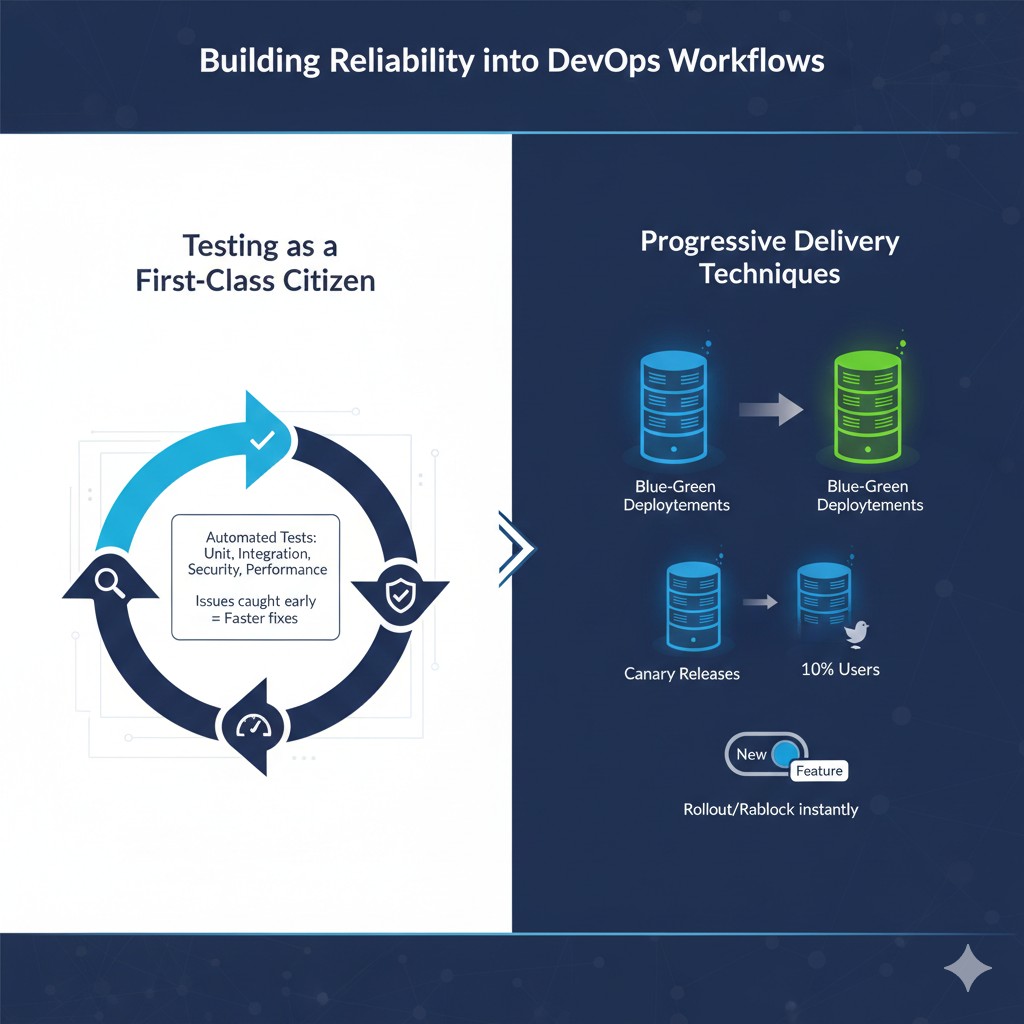
Testing as a First-Class Citizen
In effective DevOps environments, testing is not an afterthought. Automated tests—unit, integration, security, and performance—are embedded directly into pipelines. This ensures issues are caught early, before they reach production.
DevOps teams that invest in testing move faster because they spend less time fixing production incidents.
Progressive Delivery Techniques
Modern DevOps teams rely on progressive delivery methods such as:
- Blue-green deployments
- Canary releases
- Feature flags
These techniques allow teams to release changes gradually, validate behavior in production, and quickly disable features if problems arise—without full rollbacks.
DevOps Culture and Team Ownership
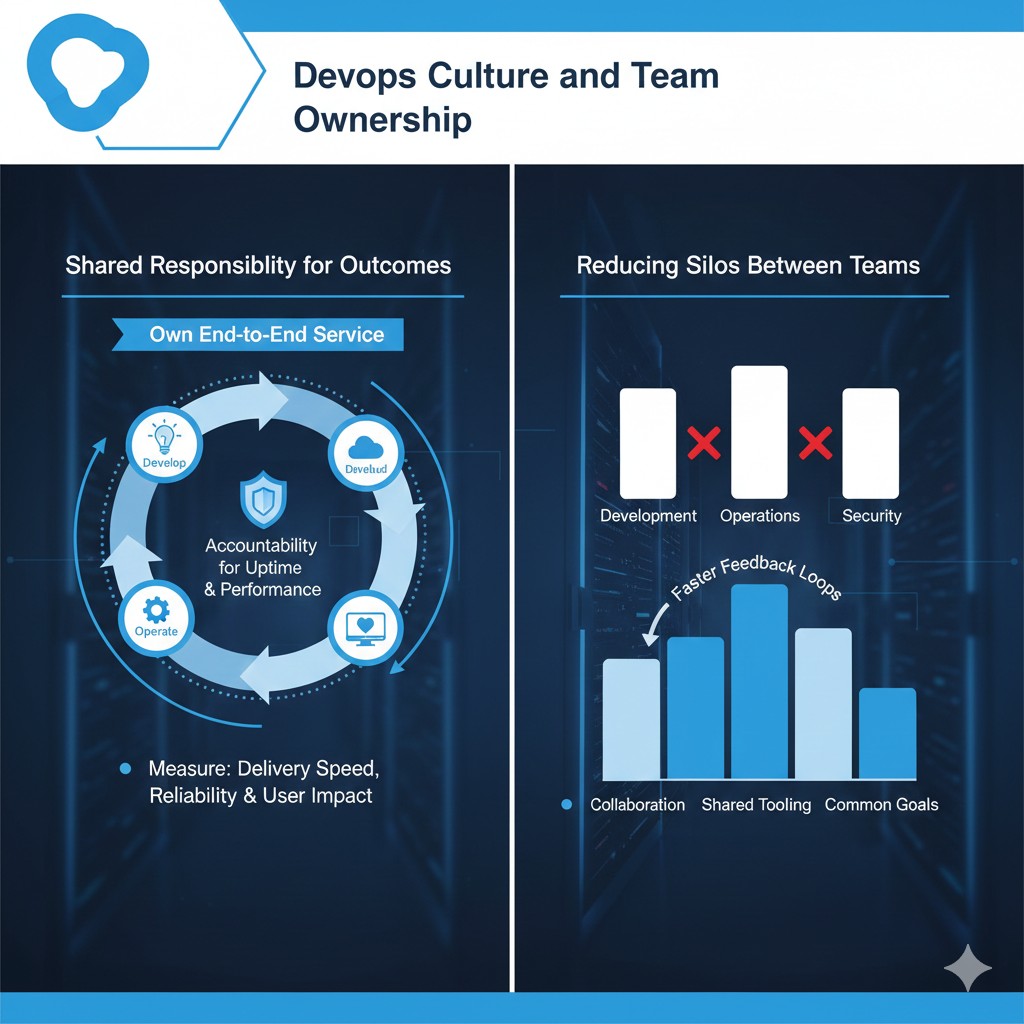
Shared Responsibility for Outcomes
In DevOps, teams own services end-to-end—from development to production. This shared responsibility changes behavior. Engineers design systems that are easier to operate because they are accountable for uptime and performance.
DevOps works best when teams measure success not just by delivery speed, but by reliability and user impact.
Reducing Silos Between Teams
Traditional handoffs between development, operations, and security slow down delivery and increase risk. DevOps breaks these silos by promoting collaboration, shared tooling, and common goals. Faster feedback loops help teams learn and improve continuously.
Observability: The Safety Net for Speed
Visibility Into Systems in Real Time
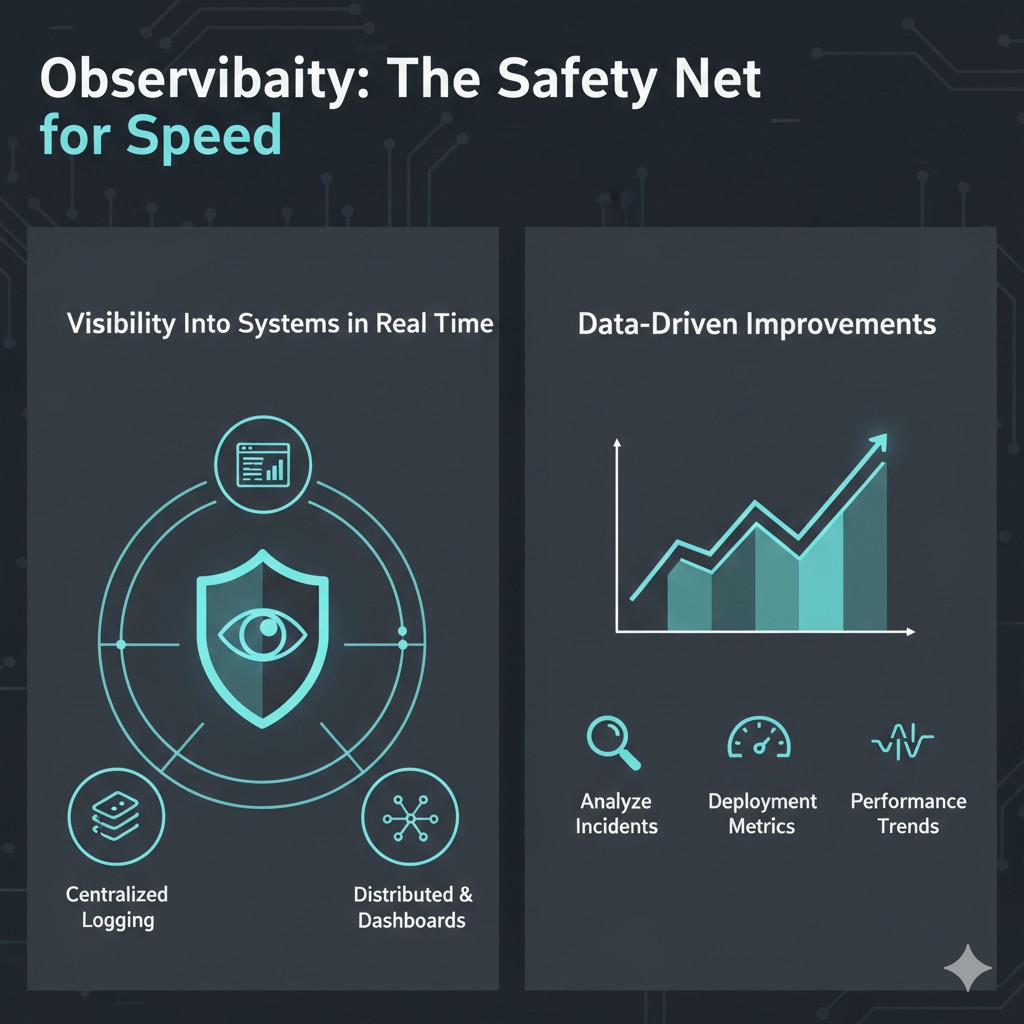
You cannot move fast safely without visibility. DevOps in practice relies on strong observability, including:
- Centralized logging
- Metrics and dashboards
- Distributed tracing
These capabilities allow teams to detect issues quickly and understand system behavior under real-world conditions within modern cloud infrastructure in 2026 environments.
These capabilities allow teams to detect issues quickly and understand system behavior under real-world conditions.
Data-Driven Improvements
High-performing DevOps teams use operational data to guide decisions. Instead of guessing, they analyze incidents, deployment metrics, and performance trends to improve systems incrementally.
Security Without Slowing Down DevOps
Integrating Security into DevOps (DevSecOps)
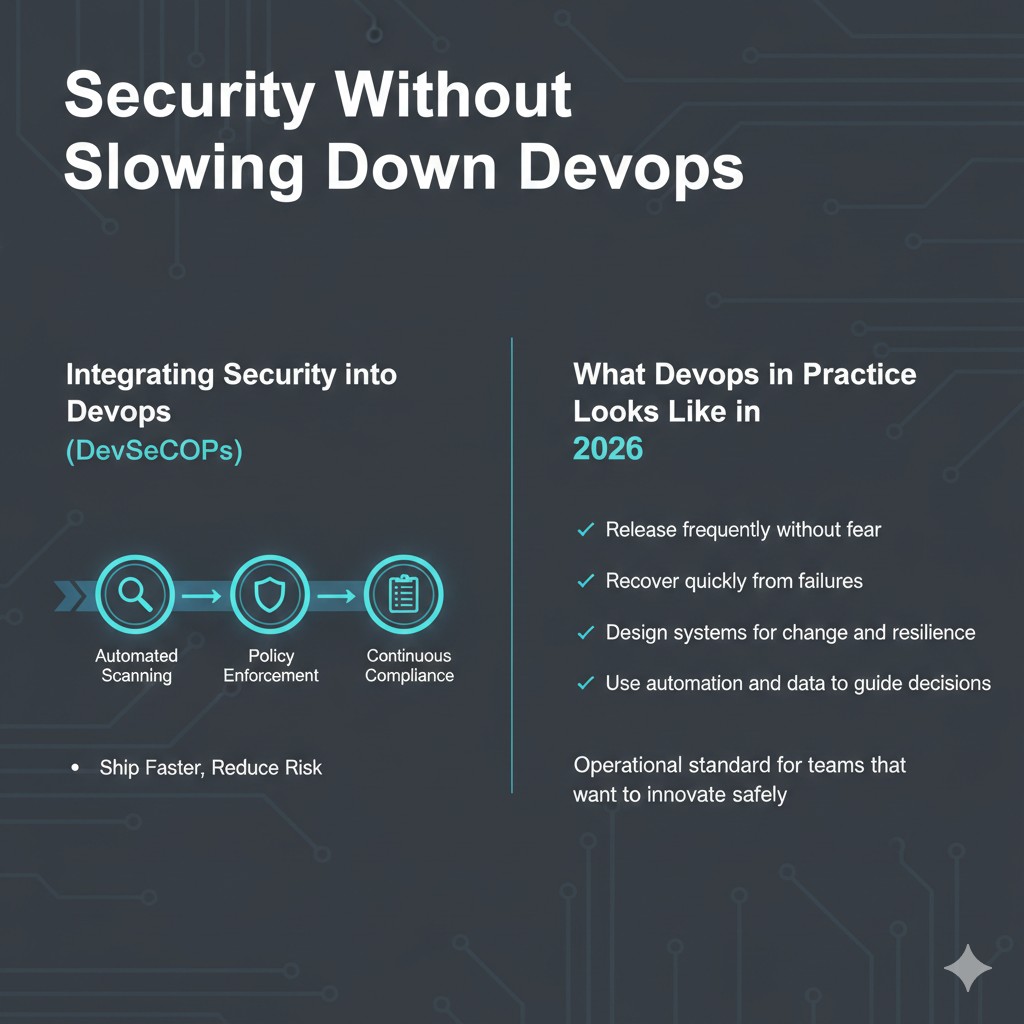
Security is often blamed for slowing delivery. In reality, security slows teams down only when it is introduced late. Modern DevOps integrates security directly into pipelines through automated scanning, policy enforcement, and continuous compliance checks.
This approach—often called DevSecOps—allows teams to ship faster while reducing risk.
What DevOps in Practice Looks Like in 2026
In 2026, DevOps maturity is defined by balance. Successful teams:
- Release frequently without fear
- Recover quickly from failures
- Design systems for change and resilience
- Use automation and data to guide decisions
DevOps is no longer experimental—it is an operational standard for teams that want to innovate safely at scale.
Final Thoughts
DevOps in practice is not about choosing speed over stability. It is about designing processes, systems, and culture that enable both. Teams that master DevOps improve delivery velocity while strengthening reliability, security, and customer trust.
In a world where change is constant, DevOps remains one of the most effective ways to move fast—without breaking systems.