
Despite years of cloud adoption, many enterprises in 2026 still struggle with inefficient, fragile, and costly systems. The problem is rarely the cloud itself—it is how organizations design and manage their cloud architecture. As digital transformation accelerates, repeating old architectural mistakes in the cloud can severely limit scalability, security, and innovation within modern cloud infrastructure in 2026 environments.
This article explores the most common cloud architecture mistakes enterprises continue to make and how these issues impact long-term business performance. Fast Tract IT Services – FZCO plays a vital role in helping organizations identify these architectural gaps and implement resilient, scalable, and cost-efficient cloud strategies that support sustainable growth.
Treating Cloud Architecture Like Traditional Infrastructure
Lifting and Shifting Without Redesign
One of the most persistent cloud architecture mistakes is the lift-and-shift approach—moving on-premise systems to the cloud without architectural changes. While this may speed up migration, it often results in:
- Poor performance
- High operational costs
- Limited scalability
Cloud architecture is not meant to replicate data centers. Without redesigning applications for cloud-native environments, enterprises fail to unlock the real benefits of the cloud.

Ignoring Cloud-Native Design Principles
Modern cloud architecture relies on microservices, containers, and managed services. Enterprises that cling to monolithic application designs create systems that are harder to scale, update, and secure. Cloud-native architecture enables agility, but only when it is intentionally designed from the start.
Overengineering Cloud Architecture
Too Much Complexity Too Soon
Another common mistake is overengineering cloud architecture in the early stages. Enterprises sometimes adopt:
- Multiple orchestration layers
- Excessive automation tools
- Overly complex networking designs
This complexity increases maintenance overhead and slows down development teams. A well-designed cloud architecture should evolve gradually, balancing simplicity with scalability.

Architecture Driven by Tools, Not Business Needs
Cloud architecture decisions should be driven by business goals—not by trends or vendor recommendations alone. Choosing tools without clear use cases often leads to fragmented systems and unnecessary costs.
Poor Cost Visibility and Architecture Decisions
Designing Without Cost Awareness
Many enterprises still design cloud architecture without understanding how costs accumulate.Poor architectural choices—such as always-on resources or inefficient storage tiers—can cause cloud spending to spiral out of control without structured cloud cost optimization strategies in place.
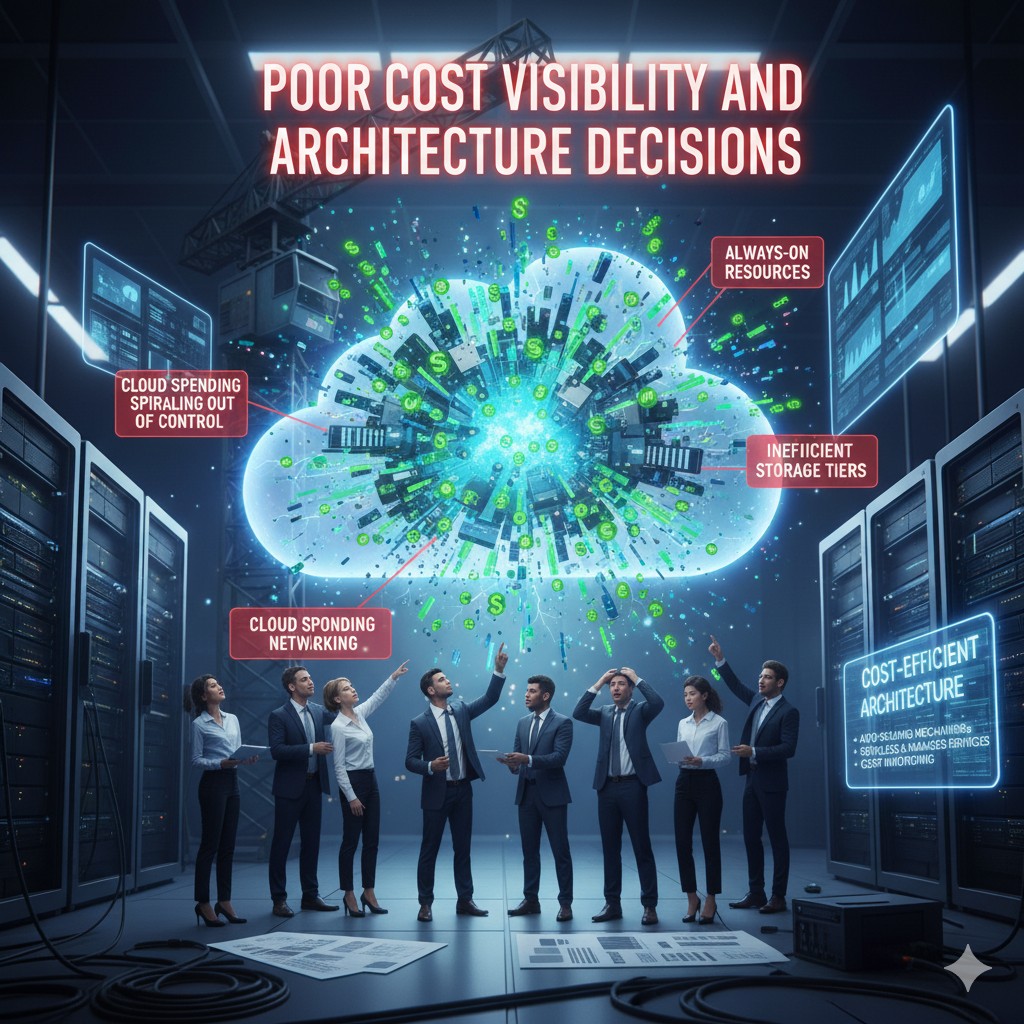
In modern cloud architecture, cost efficiency must be built into the design through:
- Auto-scaling mechanisms
- Serverless and managed services
- Continuous cost monitoring
Lack of FinOps Integration
Cloud architecture and FinOps teams often operate in silos. Without collaboration, enterprises struggle to align architecture decisions with financial accountability. In 2026, cost-aware cloud architecture is no longer optional—it is a core requirement.
Neglecting Security in Cloud Architecture Design
Treating Security as an Add-On
A major mistake enterprises still make is bolting security onto cloud architecture after deployment. This reactive approach leads to:
- Misconfigured access controls
- Exposed APIs and services
- Increased attack surfaces
Security must be embedded directly into cloud architecture, following principles such as least privilege, encryption by default, and continuous monitoring.
Inconsistent Identity and Access Management
Cloud architecture often spans multiple environments, but identity and access management is frequently inconsistent. Without centralized IAM, enterprises expose themselves to unnecessary risks and compliance challenges.
Failing to Design for Scalability and Resilience
Single Points of Failure in the Cloud
Many enterprises assume the cloud is automatically resilient. In reality, poor cloud architecture design can still create single points of failure, such as:
- Single-region deployments
- Tightly coupled services
- Lack of redundancy
True resilience requires deliberate architectural choices, including multi-region strategies and fault-tolerant designs.

Ignoring Disaster Recovery Planning
Disaster recovery is often postponed or underfunded. However, cloud architecture that lacks tested backup and recovery mechanisms puts critical business operations at risk. Resilience should be validated through regular testing—not assumed.
Underestimating Operational Complexity
No Clear Ownership of Cloud Architecture
As cloud environments grow, unclear ownership becomes a major issue. Without defined architectural governance, enterprises face:
- Inconsistent standards
- Security gaps
- Operational inefficiencies
Cloud architecture requires clear roles, documentation, and continuous oversight.
Limited Observability and Monitoring
Enterprises often fail to implement proper observability across their cloud architecture. Without centralized logging, metrics, and tracing, diagnosing issues becomes slow and reactive. In modern cloud environments, visibility is essential for performance and reliability.
How Enterprises Can Avoid These Cloud Architecture Mistakes
To build effective cloud architecture in 2026, enterprises should:
- Design with cloud-native principles from the start
- Align architecture decisions with business and cost objectives
- Embed security and compliance into the architecture
- Prioritize simplicity, scalability, and resilience
- Continuously review and evolve architectural decisions
Cloud architecture is not a one-time project—it is an ongoing discipline that must adapt as technology and business needs change.
Final Thoughts
The cloud has matured, but many enterprises are still making avoidable cloud architecture mistakes that limit performance, increase costs, and introduce risk. By rethinking how cloud architecture is designed, governed, and evolved, organizations can transform the cloud from a technical platform into a strategic advantage.
In 2026, success in the cloud depends less on whether you use it and more on how well your cloud architecture is designed.